
Prof. Diverís Vega, English Specialist
English and Spanish, two languages that share many similarities, can often create confusion due to what are known as false cognates. These are words that look or sound similar in both languages but have entirely different meanings. Understanding these tricky words is key to avoiding miscommunication in bilingual settings.
Here are a few examples of common false cognates between English and Spanish:
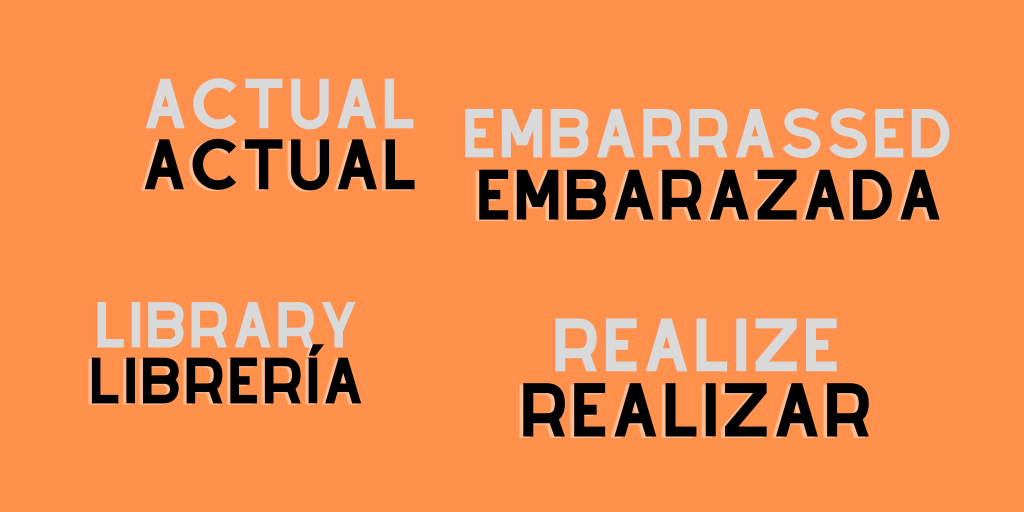
1. Actual (English) vs. Actual (Spanish)
In English, “actual” refers to something real or genuine. In Spanish, however, actual means “current” or “present.” For example:
- English: «The actual cost is higher than expected.» (meaning “real”)
- Spanish: «El problema actual es la falta de agua». (meaning “current”)
2. Embarrassed (English) vs. Embarazada (Spanish)
This is a classic example. In English, “embarrassed” means feeling awkward or ashamed, while in Spanish, embarazada translates to “pregnant.” This can easily lead to misunderstandings if one intends to express embarrassment rather than pregnancy.
3. Realize (English) vs. Realizar (Spanish)
In English, “realize” means to become aware of something, while in Spanish, realizar typically means «to carry out» or «to achieve.» These verbs often get mixed up, but they convey different ideas:
- English: «I just realized that I left my keys at home.» (meaning became aware)
- Spanish: «Voy a realizar un proyecto importante.» (meaning carry out or complete)
4. Library (English) vs. Librería (Spanish)
A “library” in English refers to a place where books are borrowed, while a librería in Spanish is a bookstore, where books are purchased.
5. Fabric (English) vs. Fábrica (Spanish)
In English, “fabric” refers to a material used to make clothes or other items, but fábrica in Spanish means “factory.” While both words are related to production, they describe very different things.
Why False Cognates Exist
False cognates typically exist because both English and Spanish share Latin roots. Over time, however, the meanings of certain words evolved differently in each language. English also has influences from Germanic languages, while Spanish developed from Vulgar/Colloquial Latin, contributing to these shifts in meaning.
Avoiding the Pitfalls of False Cognates
To avoid confusion, it is essential to:
- Verify word meanings: Using a bilingual dictionary or translator tool can help clarify whether a word is a true or false cognate.
- Engage with content in context: Reading or listening to authentic material in English can provide better insight into how certain words are used.
- Practice consistently: The more exposure to real-world usage, the easier it becomes to distinguish false cognates from true ones.
False cognates are a common challenge for learners of both languages, but with awareness and practice, it is possible to navigate these linguistic hurdles confidently.




 meta[lenguaje]
Deja un comentario