
Prof. Adriana M. López Berríos – English Specialist
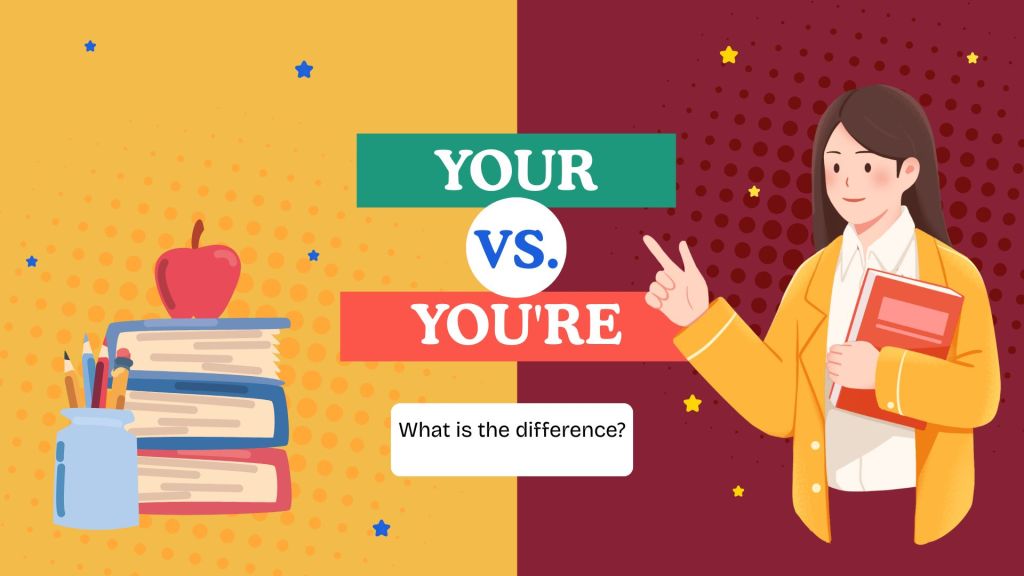
It is common knowledge that English has many words with similar pronunciations but different spellings and meanings. These words, otherwise known as homophones, can confuse both native English speakers and learners alike. In our blog we’ve already seen the examples of “Live, Leave, and Life” and “There, Their, They’re”. Today, we will be discussing how to differentiate between ‘Your’ and ‘You’re’.
Your:
When we use ‘your’, we refer to the possessive adjective that indicates when something belongs to or relates to the person or group you are speaking to.
For example:
- Is this your backpack?
- Your sandals are very nice.
- I like your sister; she’s very kind.
You’re:
On the other hand, when we use ‘you’re’ we are referring to the contraction of the words ‘you’ and ‘are’. A contraction is a word that combines two words. In this case, it combines a pronoun and a verb into a shorter form.
For example:
- You’re a very kind person.
- You’re a lifesaver!
- I can’t believe you’re here!
Let’s Practice!
If you would like to try out what you have learned and see if you can tell the difference between these two words, head to the link below for a short practice exercise.
https://webapps.towson.edu/ows/exercises/YourYou’reExercise2.aspx
Reference:
IDP IELTS. (2025, November 21). Your vs You’re: Learn the difference. https://ielts.idp.com/prepare/article-your-vs-youre-learn-the-difference




 meta[lenguaje]
Deja un comentario